
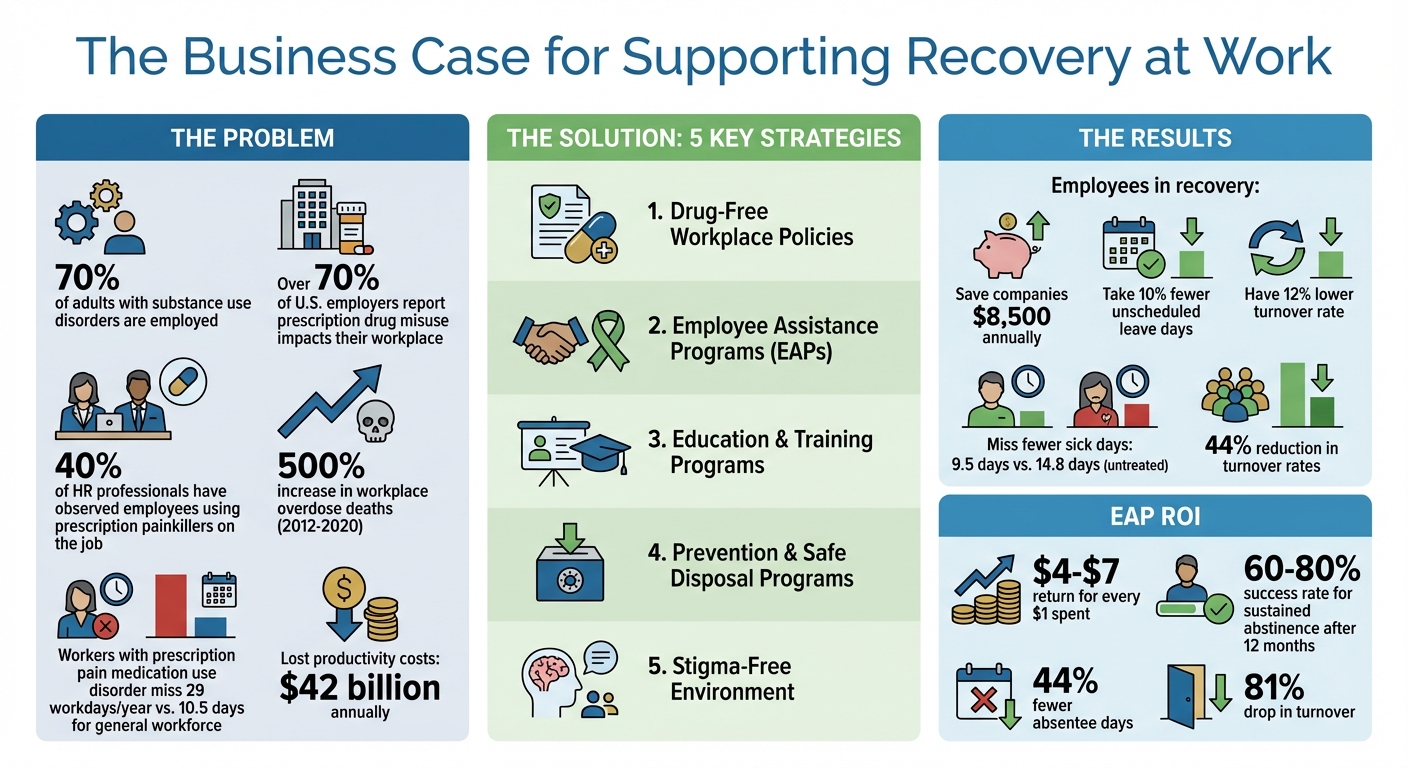
Prescription drug misuse is a growing workplace issue, affecting safety, productivity, and costs. Nearly 70% of adults with substance use disorders are employed, and their struggles can lead to absenteeism, turnover, and workplace injuries. But with the right strategies, employers can actively support recovery and improve workplace outcomes.
Key takeaways:
- Employees in recovery save companies $8,500 annually and take fewer sick days.
- Drug-free workplace policies, Employee Assistance Programs (EAPs), and education are effective tools.
- Prevention measures, like safe medication disposal, and creating stigma-free environments, encourage recovery.
This article outlines five practical strategies to address prescription drug misuse and support employees on their recovery journey.
Impact of Workplace Recovery Support Programs on Employee Performance and Business Costs
Becoming a Recovery-Ready Workplace Using the Department of Labor Toolkit
sbb-itb-17645e5
The Problem: Prescription Drug Misuse at Work
Prescription drug misuse is not confined to any one type of workplace. It happens in office cubicles, on factory floors, and at construction sites all across the United States. In 2022, nearly two-thirds of the 46 million Americans dealing with a substance use disorder were employed. Among adults who misused opioids in 2021, about half held full- or part-time jobs.
The issue is pervasive, with over 70% of U.S. employers reporting that prescription drug misuse has directly impacted their workplaces. Alarmingly, 40% of HR professionals have observed employees using prescription painkillers on the job, and 15% have encountered workplace injuries or near-misses tied to drug misuse. The numbers are even more sobering when you consider that workplace deaths from unintentional overdoses surged by nearly 500% between 2012 and 2020.
“Employers must understand that the most dangerously misused drug today may be sitting in employees’ medicine cabinets.”
- Deborah A.P. Hersman, President and CEO, National Safety Council
Certain industries bear the brunt of this crisis. For example, the construction industry, as well as the entertainment, recreation, and food service sectors, report substance use disorder rates of 15% or more – almost double the national workforce average of 9.4%. These environments, often high-stress, male-dominated, and populated by younger employees, create conditions where misuse can thrive.
What Causes Prescription Drug Misuse
Interestingly, most cases of workplace prescription drug misuse don’t start with illegal activity. Instead, they often begin with a legitimate prescription. In fact, 63.4% of adults who misuse pain relievers do so to manage physical pain, often from workplace injuries or chronic conditions. Physically demanding jobs frequently involve opioid prescriptions after accidents, which can unintentionally lead to dependency.
Misuse tends to follow a pattern: it starts with appropriate use, escalates to higher doses or extended use, and eventually leads to illicit acquisition of the drugs. Stressors like job insecurity and workplace conflicts can accelerate this cycle.
Different types of prescription drugs are misused for specific reasons. Sedatives are commonly used for sleep (73.2%), while stimulants are taken to stay alert (28.4%) or improve focus (26.2%). Tranquilizers, on the other hand, are often used to relax or relieve tension (46.2%) and to aid sleep (21.2%).
Pain medication poses a unique risk by masking physical discomfort. Dr. Susan Murray, Professor of Engineering Management at Missouri University of Science and Technology, notes:
“Masked discomfort may lead employees to engage in risky behaviors and overexert themselves.”
This cycle not only endangers health but also directly impacts job performance, as outlined below.
How Misuse Affects Job Performance
The effects of prescription drug misuse ripple across workplaces, creating both human and financial costs. Workers with a prescription pain medication use disorder miss an average of 29 workdays each year – almost triple the 10.5 days missed by the general workforce. Employees with any substance use disorder miss about 24.6 days annually, compared to 15 days for their peers.
Lost productivity from prescription drug misuse costs U.S. employers approximately $42 billion every year. Employees struggling with misuse are 2 to 5 times more likely to take unexcused absences, show up late, or file workers’ compensation claims. The turnover rate is also telling: 42% of workers with pain medication disorders had more than one employer within a year, compared to 25% of the general workforce.
Safety risks skyrocket when prescription drugs impair essential cognitive functions like focus, attention to detail, and reaction time. Overdoses now account for nearly 1 in 11 workplace deaths. Adding to the financial strain, injured employees prescribed opioids face total claim costs that are four times higher than similar claims without opioids.
The psychological toll is equally concerning. Workers with pain medication disorders are more than twice as likely to require hospitalization, and 28% report serious psychological distress – seven times higher than the 4% reported by the general workforce. This mental health burden erodes team morale and contributes to “presenteeism”, where employees are physically present but mentally disengaged.
Despite these challenges, most employers feel unequipped to tackle the issue. Only 19% say they are “extremely prepared” to address prescription drug misuse, and 76% lack training programs to help employees or supervisors recognize the warning signs. These statistics highlight the pressing need for workplace strategies focused on prevention and recovery.
Solution 1: Drug-Free Workplace Policies
A well-thought-out drug-free workplace policy not only ensures safety but also supports employees on their recovery journey. The key difference between traditional policies and those designed for recovery lies in perspective: effective policies view substance use disorder (SUD) as a treatable condition, not a moral failing. This shift allows employees to seek help without fearing immediate job loss.
These policies establish clear rules while offering recovery support. They define banned substances and behaviors and provide access to treatment and recovery resources. Studies show that employees in recovery take nearly 10% fewer unscheduled leave days annually compared to the general workforce and have a 12% lower turnover rate. Considering that replacing an employee typically costs about 21% of their annual salary and benefits, supporting recovery is also a smart financial move.
What Makes a Policy Effective
An effective drug-free workplace policy combines several critical elements. The statement of purpose sets the tone, prioritizing health and safety over punishment. Clear definitions follow, specifying prohibited substances (including misuse of prescription drugs), outlining unacceptable behaviors, and clarifying when and where these rules apply.
Confidentiality protections are crucial. Any medical information related to SUD should be kept separate from general personnel files. This safeguard encourages employees to seek help without worrying about their reputation or career progression.
The policy should also address legal protections and accommodations. Under the Americans with Disabilities Act (ADA), employers must support employees in recovery, which could include allowing the use of legally prescribed medications like those used in Medication-Assisted Treatment (MAT). Employers might also offer flexible schedules for counseling or adjust workplace conditions to reduce stressors that could lead to relapse.
Drug testing protocols are another key area. In a recovery-focused workplace, a positive drug test becomes an opportunity for intervention, not immediate termination. Policies should outline clear pathways for treatment referrals and emphasize support over punishment.
| Policy Component | Purpose | Recovery-Supportive Element |
|---|---|---|
| Statement of Purpose | Sets tone and legal framework | Frames SUD as a treatable health condition |
| Drug Testing Protocols | Ensures safety and compliance | Provides treatment referral pathways for positive tests |
| EAP Integration | Offers immediate help | Includes confidential counseling and access to MAT |
| Disciplinary Procedures | Maintains workplace standards | Focuses on “second-chance” agreements instead of termination |
| Training & Education | Builds awareness | Reduces stigma and promotes practical coping strategies |
Clear rules paired with supportive measures ensure policies are enforced fairly and empathetically.
Enforcing Rules While Supporting Employees
Enforcement of these policies should focus on support rather than punishment. Zero-tolerance policies often discourage employees from seeking help. Instead, employers can implement “fair chance” agreements (previously known as last-chance agreements), which allow employees to keep their jobs while they pursue treatment and agree to periodic testing. These agreements typically require employees to complete treatment programs, attend counseling, and undergo follow-up testing. They provide structure while giving employees a real chance to recover and maintain their livelihoods.
The U.S. Department of Labor underscores this supportive approach:
“Positive drug tests are first and foremost an opportunity to engage employees and support them in stopping drug use whenever possible.”
Supervisor training is another critical piece. Managers should be trained to recognize performance issues, document them objectively, and avoid stigma or moral judgments. They need to know how to start conversations about available resources and when to refer employees to Employee Assistance Programs. The focus should always be on addressing performance concerns while connecting employees to the help they need – not on diagnosing or shaming them.
When employees request recovery accommodations, employers should begin a collaborative process. This might involve adjusting schedules for support group meetings or temporarily reassigning tasks to reduce stress. These accommodations maintain workplace standards while acknowledging that recovery is a continuous process requiring flexibility.
Some companies take it a step further by addressing workplace conditions that may contribute to substance misuse. For example, reducing excessive workloads, finding alternatives to opioids for managing chronic pain, and resolving workplace conflicts can help prevent relapse and support long-term recovery. Even small changes, like hosting alcohol-free events instead of traditional happy hours, can make employees in recovery feel included rather than isolated.
Solution 2: Employee Assistance Programs (EAPs)
Employee Assistance Programs (EAPs) offer a confidential lifeline for employees dealing with prescription drug misuse. Unlike policies that merely set rules, EAPs provide real, hands-on support through professional screenings, short-term counseling, and referrals to specialized treatment programs. With about 30% of EAP cases involving alcohol or drug issues, these programs are a key resource for tackling substance use in the workplace. They work seamlessly alongside drug-free workplace policies by offering recovery-focused services.
One of the standout features of EAPs is their strict confidentiality. Governed by HIPAA and 42 CFR Part 2, they ensure that clinical details remain private unless the employee explicitly consents. This privacy encourages employees to seek help early – before their performance declines to the point of disciplinary action. And the results are promising: workplace-based interventions through EAPs have success rates of 60% to 80% for sustained abstinence after 12 months.
The financial benefits of EAPs are equally striking. For every dollar spent on these programs, companies see a return of $4–$7. A study at McDonnell Douglas Corporation revealed that employees who used EAPs for drug-related issues had 44% fewer absentee days and an 81% drop in turnover compared to those who sought treatment outside the program. Over three years, this translated to more than $4 million in savings on medical claims.
EAPs also equip supervisors with tools like constructive confrontation. This method focuses on documenting observable declines in performance rather than attempting to diagnose addiction. By basing referrals on clear work-related data, this approach helps reduce stigma and fosters a supportive environment. It’s a shift from punitive measures to objective, recovery-oriented intervention.
EAPs vs. Disciplinary Approaches
The contrast between EAPs and traditional disciplinary methods lies in their purpose and results. Disciplinary actions focus on enforcing compliance, often through punishment, while EAPs aim to rehabilitate and retain employees. The table below highlights the key differences:
| Approach | Pros | Cons | Implementation Steps |
|---|---|---|---|
| Employee Assistance Programs (EAPs) | Offers confidential recovery support; Enhances employee retention; Focuses on long-term solutions | Requires upfront investment; May need awareness campaigns to boost participation | Partner with EAP providers; Train HR and supervisors |
| Traditional Disciplinary Approaches | Enforces rules quickly; Deters policy violations | Can create fear and stigma; Often leads to higher turnover; Neglects recovery efforts | Establish clear policies; Focus on punitive measures |
The data is clear: employees with untreated substance use disorders are 2.5 times more likely to be absent and 3.6 times more likely to be involved in workplace accidents. On the other hand, recovery-focused programs like EAPs significantly reduce absenteeism and boost employee retention. By blending confidential support with proactive supervisor training, EAPs foster a workplace culture that prioritizes recovery and safety while delivering measurable cost savings.
Solution 3: Education and Training Programs
Education plays a crucial role in shaping how workplaces address prescription drug misuse. With workplace overdose deaths increasing by 536% since 2011 and overdoses now accounting for nearly 1 in 11 worker fatalities, the need for informed responses is more urgent than ever. Yet, only 11% of HR professionals have received specialized training, leaving many managers ill-equipped to recognize warning signs or handle situations with compassion. Education provides the knowledge needed to identify issues early and complements other recovery strategies.
Training programs should cover the fundamentals of prescription drug dependency, including how these substances affect brain function and the benefits of Medication-Assisted Treatment (MAT). The aim is to reframe substance use disorder as a chronic, treatable condition rather than a moral failing. This perspective shift can encourage employees to seek help before their performance deteriorates to a critical level.
“Substance use disorder is an issue every organization will confront. The question is whether we address it proactively with constructive policies or wait for crises to dictate our decisions.” – Dr. Amy Dufrane, CEO, HRCI
The statistics highlight the stakes: workers with untreated substance use disorders take nearly 50% more unscheduled days off and have a 44% higher turnover rate than the general workforce. On the other hand, employees in recovery – those who have received treatment and remained disorder-free for 12 months – miss fewer days annually (10.9) than the general workforce average of 15 days.
In-person training tends to be more engaging, but online modules offer a flexible alternative. Employers can also use free resources from federal campaigns like the CDC’s “Rx Awareness” or SAMHSA’s “National Prevention Week” to minimize costs. Collaborating with Employee Assistance Programs and labor unions to co-host sessions can further enhance participation and trust. This educational groundwork sets the stage for more targeted training efforts.
Training Managers and HR Staff
Supervisors need specific tools to recognize signs of impairment without crossing legal boundaries. Training should focus on observable performance issues – such as increased absenteeism or missed deadlines – while steering clear of diagnostic judgments that could violate ADA guidelines. Empathy and legal awareness are key components of this approach.
A lack of knowledge and stigma are significant barriers to creating recovery-friendly workplaces. Sixty-four percent of HR professionals cite insufficient knowledge, while 59% point to stigma as a major challenge. By understanding that substance use disorder affects brain function and behavior rather than character, managers can guide employees toward supportive resources instead of resorting to punitive measures.
“Stand beside them shoulder-to-shoulder in their fight, because they are fighting for their lives as if this was a battle with cancer or any other horrible disease.” – Jo McGuire, Executive Director, National Drug and Alcohol Screening Association
Training also includes naloxone administration for safety teams, equipping them to reverse opioid overdoses in emergencies. For industries where machinery or driving is involved, recognizing impairment becomes even more critical. Managers should also learn about reasonable accommodations, such as flexible schedules for 12-step meetings or modified duties during early recovery. These efforts help foster a workplace culture that supports recovery.
Workshops and Resources for Employees
While manager training builds leadership skills, employee workshops ensure the entire workforce is informed and empowered. These sessions focus on prevention and early intervention, covering the risks of prescription drug misuse, alternative pain management strategies, and ways to support coworkers returning from treatment.
Education should be an ongoing effort, as changing attitudes and dispelling misinformation requires consistent messaging. Employers can integrate brief prevention tips into newsletters, internal websites, and team meetings to keep the conversation active without overwhelming staff. Using person-first language – like “person in recovery” instead of “addict” – helps reduce stigma and promotes a more supportive environment.
Workshops should also explain legal protections under the ADA and Family and Medical Leave Act, ensuring employees understand their rights to reasonable accommodations and medical leave. When workers know they won’t face automatic termination for seeking help, they are more likely to use available resources before a crisis arises. Encouraging employees in recovery to share their experiences can further create a safe and open workplace culture. For additional resources, platforms like Sober Living Centers offer comprehensive information to supplement workplace training initiatives.
Solution 4: Prevention and Safe Disposal Programs
Taking steps to prevent workplace injuries can significantly cut down on the need for prescription painkillers. In 2022, 32% of workers’ compensation claims involving prescriptions included at least one opioid. By prioritizing ergonomic adjustments, thorough safety training, and proactive injury prevention, employers can reduce the number of incidents that lead to opioid prescriptions.
Another critical issue is addressing unused medications. Research reveals that six out of 10 patients prescribed opioid painkillers end up with leftover pills, and 47% of Americans keep between one and three bottles of unused prescriptions at home. Alarmingly, over 75% of people who develop opioid dependence report starting with pills obtained from someone they knew. Combining safe disposal practices with strong workplace safety measures can significantly reduce these risks.
Workplace Safety Measures
Preventing injuries at work begins with identifying and addressing potential hazards. Employers should assess job demands, improve workplace ergonomics, and supply appropriate safety equipment to reduce physical strain that could lead to chronic pain. If injuries occur, offering non-opioid pain management options – such as physical therapy, cognitive behavioral therapy, or acupuncture – can help employees avoid reliance on prescription drugs.
For roles involving safety-sensitive tasks, such as operating machinery or driving commercially, clear policies around medication use are essential. Employee handbooks should require workers in these positions to notify management if they are taking medications that might impair their performance. Temporary adjustments to job duties can allow employees to manage pain safely while maintaining workplace safety.
Safe Medication Disposal Options
Employers can also play a role in promoting safe disposal of unused medications. Offering at-home drug deactivation kits, such as small bottles or pouches, is one effective solution. These kits chemically neutralize pills, capsules, patches, or liquids, making them safe for disposal. Another option is mail-back envelopes, which let employees safely and anonymously dispose of medications through the mail.
“By providing a safe and convenient method for employees to dispose of medications from their homes, Rx Destroyer empowers individuals to prioritize their health with confidence and care.” – Keely Sibbald, Executive Director of People and Culture, Daniels Health
While on-site collection kiosks are an option, they are heavily regulated by the DEA under Title 21 CFR Section 1317 and are typically limited to retail pharmacies, law enforcement, or healthcare facilities with on-site pharmacies. For most employers, at-home kits and mail-back programs are simpler and more practical to implement.
Education is just as important as providing disposal tools. Studies show that 18% of Americans are unaware of how to safely dispose of unused medications, and many resort to unsafe methods – 29% throw them in the trash, and 26% flush them down the drain. Employers can address this by pairing disposal options with clear instructions, such as through newsletters, safety talks, or “Warn-Me” labels. These efforts ensure employees understand the dangers of keeping unused medications and how to dispose of them responsibly.
Safe disposal programs not only reduce risks but also empower employees to take control of their health. For further guidance on safe medication practices or recovery resources, employers can direct their teams to Sober Living Centers.
Solution 5: Creating a Stigma-Free Environment
Breaking the stigma around addiction is crucial. Fear of judgment often pushes employees to hide their struggles, which only worsens the situation. In 2023, 72% of employers said they were unwilling to hire someone with a known substance use disorder, and nearly two-thirds of employees expressed discomfort working closely with someone in recovery. This bias silences many, despite the fact that around 70% of adults with a substance use disorder are currently employed.
The shift toward a stigma-free workplace starts with leadership. When leaders treat addiction as a chronic, treatable medical condition rather than a moral failure, it sets a positive tone across the organization. For example, Hilton introduced a company-wide conversation series in 2023 as part of its Diversity, Equity, and Inclusion efforts. This initiative encouraged open discussions on difficult topics, including substance use disorders, helping employees feel more at ease engaging in these conversations.
“The biggest role employers can play is around stigma. Employers have to normalize conversations around SUD [to help] those struggling to feel more confident about engaging in those discussions.” – Amanta Mazumdar, Vice President of Americas Total Rewards, Hilton
Such leadership efforts pave the way for open, stigma-free conversations throughout the workplace.
Encouraging Open Conversations
Leadership support is just the beginning – practical steps are needed to foster open dialogue. Managers play a key role here. Training them to recognize signs of substance misuse and connect employees to confidential support services – rather than resorting to disciplinary actions – is critical.
“Educating yourself is important as well as having open conversations that start at the top, along with understanding what conscious or unconscious bias you might have about those struggling with addiction.” – Kirsten Suto Seckler, Chief Marketing and Communications Officer, Shatterproof
Workplace norms also need rethinking. Social events that exclude or trigger employees in recovery can perpetuate stigma. Kaiser Permanente’s Addiction Medicine Program, led by Paul Bryant, made a conscious decision to remove alcohol from healthcare group meetings, creating a more inclusive environment. Similarly, Hilton replaced traditional “happy hour” events with activities like group hikes. These changes send a clear message: recovery is supported, not sidelined.
Workplace Naloxone Programs
Another way to promote a stigma-free culture is through proactive health measures like naloxone programs. Naloxone (commonly known as Narcan) is a medication that can reverse opioid overdoses by addressing respiratory depression, the leading cause of death in such cases. With workplace overdose deaths increasing nearly 500% between 2012 and 2020, having naloxone on-site could save lives.
In 2023, Genfoot, a New Hampshire-based boot manufacturer, installed opioid emergency kits in its workplace to enhance safety and prevent overdoses. Experts liken naloxone to Automated External Defibrillators (AEDs) – both address life-threatening emergencies and reflect an employer’s commitment to employee well-being.
“Although extreme opioid use isn’t traditionally labeled a workplace hazard, just as companies invest in AEDs to counter heart disease, they can similarly invest in naloxone to protect employee health.” – Adam Calli, Principal Consultant, Arc Human Capital LLC
Naloxone kits cost $40 to $75 for a two-dose package, but many local and state health departments offer free kits and training. By implementing naloxone programs, employers not only save lives but also reinforce a workplace culture that prioritizes health and recovery. For further resources, employers can guide their teams to Sober Living Centers.
Conclusion
Helping employees recover from substance use disorders isn’t just compassionate – it’s good business. By implementing drug-free workplace policies, offering strong Employee Assistance Programs (EAPs), providing education, focusing on prevention, and fostering stigma-free environments, employers can create what experts refer to as a “Workplace Supported Recovery” setting. In such environments, work-related factors are less likely to contribute to substance use, and employees feel more comfortable seeking the help they need.
The benefits of these strategies are clear. Research shows that employees in recovery save companies over $8,500 annually, take fewer sick days (9.5 compared to 14.8 for untreated cases), and reduce turnover rates by 44%.
Considering that nearly 70% of individuals with substance use disorders are actively employed, workplaces play a crucial role in supporting recovery. Some organizations have even achieved Recovery Friendly Workplace certification, showcasing their dedication to these practices. These companies understand that prioritizing recovery leads to reduced absenteeism, lower healthcare expenses, and stronger employee loyalty.
For those seeking resources on recovery and treatment, Sober Living Centers offers valuable educational materials on substance use disorders, prevention, and treatment options. By championing recovery, workplaces not only help employees regain their health and productivity but also cultivate a dependable and engaged workforce.
FAQs
How can my employer support recovery without risking safety?
Employers can play a vital role in supporting recovery while keeping the workplace safe. This starts with creating a recovery-friendly environment by implementing clear policies, offering Employee Assistance Programs (EAPs), and providing manager training to handle substance use issues with care and understanding.
Education is key to reducing stigma around substance use disorders. By promoting awareness and encouraging access to counseling and treatment programs, employers can help employees feel more comfortable seeking the help they need. When these initiatives are paired with robust safety protocols, workplaces can balance security with meaningful recovery support.
What should I do if I think a coworker is impaired at work?
If you think a coworker might be impaired, it’s important to stay calm and focus on safety. Handle the situation carefully to avoid making it worse. Start by addressing any urgent safety issues, but keep things from escalating. If it feels appropriate, consider having a respectful, private conversation and take note of specific behaviors you’ve observed.
For roles where safety is critical, it’s essential to report your concerns to a supervisor or HR as soon as possible. The goal is to maintain a safe work environment without resorting to confrontation or passing judgment.
Can I get help through an EAP without my manager finding out?
Yes, Employee Assistance Programs (EAPs) are completely confidential. This means your employer won’t be informed if you choose to use these services. EAPs are specifically designed to offer private support for employees dealing with personal challenges, such as substance misuse or recovery, without involving management in the process.