Mindfulness is a core skill in Dialectical Behavior Therapy (DBT) that helps manage cravings, regulate emotions, and reduce relapse risks during addiction recovery. By focusing on the present moment without judgment, mindfulness creates a pause between triggers and actions, allowing for healthier decisions. Research shows mindfulness can improve emotional regulation by 40%, reduce cravings by 30%, and lower relapse rates by up to 30%.
Here’s how mindfulness works in DBT:
- “What” Skills: Observe, describe, and participate to address cravings and stay engaged in the present.
- “How” Skills: Practice non-judgmentally, one-mindfully, and effectively to reduce shame and guilt.
- Techniques: Use breathing exercises (e.g., Box Breathing, 4-7-8 Technique), body scans, and mindful journaling to stay grounded.
Mindfulness not only helps manage cravings but also strengthens emotional control and improves overall mental health, making it a practical tool for lasting recovery.
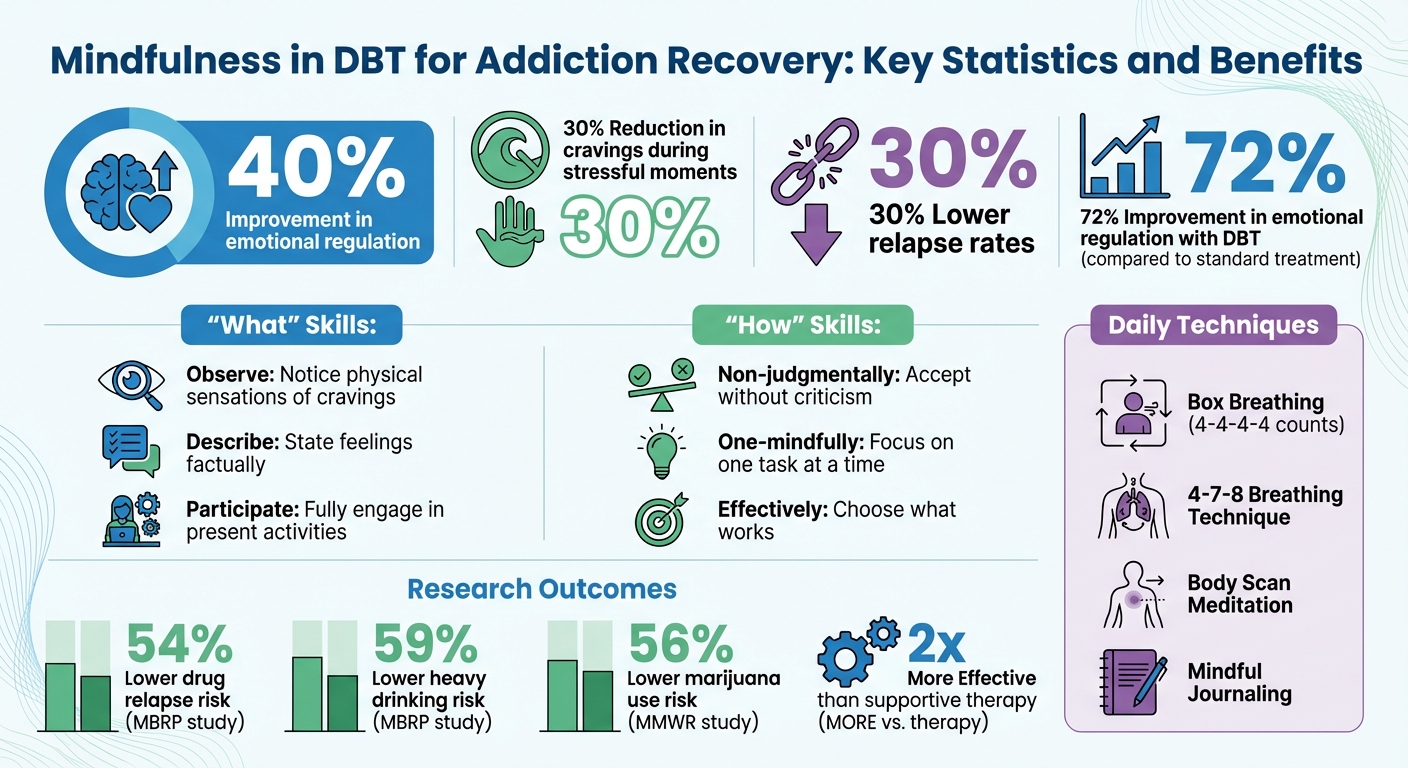
Mindfulness in DBT for Addiction Recovery: Key Statistics and Benefits
What is Mindfulness in DBT
Defining Mindfulness
In Dialectical Behavior Therapy (DBT), mindfulness means intentionally tuning into the present moment, stepping away from autopilot, and fully observing both internal and external experiences.
For those navigating addiction recovery, this shift is critical. Instead of automatically reacting to cravings or triggers, mindfulness introduces a pause – a moment to breathe and consider a healthier response. This pause can be the difference between falling into old habits and making a positive choice.
By noticing sensations without attaching labels, mindfulness also helps reduce feelings of shame and guilt, which often fuel addiction. This nonjudgmental awareness makes it easier to handle tough emotions without turning to substances as a coping mechanism.
DBT places mindfulness at the heart of its approach, making it the foundation for all other skills taught in the therapy.
Mindfulness as a Core DBT Skill
Mindfulness is the backbone of all DBT techniques, supporting distress tolerance, emotion regulation, and interpersonal effectiveness. As noted by the Bay Area DBT & Couples Counseling Center, mindfulness is the cornerstone skill in DBT. Without it, the effectiveness of the other modules diminishes.
DBT breaks mindfulness into two main categories: “What” skills (Observe, Describe, Participate) and “How” skills (Non-judgmentally, One-mindfully, Effectively). Together, these skills guide individuals toward accessing their “Wise Mind” – a balanced mental state where logic and emotion work in harmony. In this state, you can process intense emotions while still thinking clearly, leading to better decision-making during recovery.
For those overcoming addiction, these mindfulness skills are transformative. They help reframe cravings as temporary sensations rather than commands that must be acted upon. This shift in perspective empowers individuals to endure and move past urges instead of feeling controlled by them.
sbb-itb-17645e5
Practical DBT: Mindfulness Techniques for Substance Abuse
Core Mindfulness Skills in DBT for Addiction
Dialectical Behavior Therapy (DBT) introduces mindfulness through two main sets of skills: the “What” skills (Observe, Describe, Participate) and the “How” skills (Non-judgmentally, One-mindfully, Effectively). These tools are designed to help you navigate cravings, manage triggers, and make thoughtful choices during recovery.
Research highlights that individuals undergoing DBT can experience up to a 72% improvement in emotional regulation and a reduction in substance use incidents compared to standard treatments. These skills create a crucial pause between triggers and actions, allowing space for better decision-making. Let’s break down each skill to understand how they can help during moments of craving or stress.
Observe, Describe, and Participate
The Observe and Describe skills work hand in hand to help you address cravings. When a craving surfaces, start by observing the physical sensations without immediately reacting. Then, describe it in a neutral, factual way – like saying, “I feel tightness in my chest and a thought about using.” This approach allows you to see the craving as just a thought, not a command to act. Studies show that practicing mindfulness in this way can reduce cravings by 30% during stressful moments.
The Participate skill encourages you to fully engage in whatever you’re doing – whether it’s talking with someone, taking a walk, or doing household tasks. By immersing yourself in the present, you avoid dwelling on regrets or anxieties, both of which can trigger a relapse.
Taking a Non-Judgmental Stance
Adopting a non-judgmental stance means observing your thoughts and feelings without labeling them as “good” or “bad.” In recovery, this skill can help you avoid self-critical thoughts like “I’m a failure”, which often lead to shame and guilt – two major relapse triggers. DBT emphasizes separating the facts of what’s happening from the emotional judgments we attach to them. For instance, instead of saying, “I should be sober”, try reframing it as, “I want to be sober.” This subtle shift reduces emotional intensity and fosters self-acceptance.
One-Mindfully
The One-Mindfully skill is all about focusing your full attention on one task at a time. For example, if you’re washing dishes, concentrate solely on the act instead of replaying past arguments or worrying about what’s next. This kind of focused attention can break negative thought patterns that often lead to substance use. In stressful moments, even something as simple as focusing on your breath can help quiet a fragmented mind. Regular practice of this skill has been shown to lower relapse rates by up to 30%.
| Skill | Application in Addiction Recovery | Benefit |
|---|---|---|
| Observe | Noticing the physical sensations of a craving | Helps prevent impulsive reactions to triggers |
| Describe | Stating feelings factually (e.g., “I’m thinking about drinking”) | Reduces the power of cravings over your actions |
| Participate | Fully engaging in an activity | Reduces the urge to escape through substance use |
| Taking a Non-Judgmental Stance | Accepting cravings or lapses without self-criticism | Minimizes shame and guilt, fostering self-compassion |
| One-Mindfully | Focusing completely on the present moment | Interrupts negative thought cycles |
These mindfulness skills come together to form a practical system for managing overwhelming emotions and making healthier choices during recovery.
Mindfulness Techniques You Can Use Daily
Incorporate DBT mindfulness skills into your daily life with these practical, easy-to-use methods.
Mindfulness doesn’t require hours of practice – just a few intentional minutes each day can help you manage cravings, reduce stress, and stay grounded during recovery. Here are some techniques to seamlessly weave mindfulness into your routine.
Breathing Exercises for Managing Cravings
Breathing exercises are a simple yet powerful way to calm your mind and body when cravings hit. One great method is Box Breathing. Here’s how it works: find a quiet spot, close your eyes, and inhale slowly through your nose for a count of four. Hold your breath for four seconds, exhale through your mouth for four seconds, and pause for another four seconds before starting the cycle again. This structured breathing helps create a moment of calm, giving you space to respond thoughtfully instead of reacting impulsively.
Another option is the 4-7-8 Technique. Breathe in through your nose for four counts, hold your breath for seven counts, and exhale forcefully through your mouth with a “whoosh” sound for eight counts. Both Box Breathing and the 4-7-8 Technique have been shown to reduce cravings by up to 30% during stressful moments. For a shorter practice, try the 3-Minute Breathing Space: spend one minute observing your thoughts and feelings, one minute focusing on your breath, and one minute expanding your awareness to your entire body.
These breathing exercises are a great starting point, but mindfulness can go even deeper when you tune into your body.
Body Scan Meditation
Body scan meditation is a practice that helps you reconnect with your body’s sensations – something that might feel unfamiliar after addiction. To begin, sit or lie down comfortably and notice the feeling of your feet on the ground. Then, slowly guide your attention through your body, starting from your toes and moving upward through your legs, torso, arms, and head. Pay attention to any sensations – whether it’s tension, tingling, or warmth – without judging or trying to change them.
This practice is especially useful before bed or as part of a morning routine. It not only helps release tension but also makes you more aware of how stress or cravings physically manifest, giving you the tools to address them mindfully.
Pair this physical awareness with reflective practices for a more comprehensive mindfulness approach.
Mindful Journaling
Journaling with mindfulness allows you to process your thoughts and emotions while identifying patterns and triggers. It’s a great way to put DBT principles into action by externalizing your internal experiences in a non-judgmental way.
One structured approach is the DBT Thought Record. Start by writing down a specific negative thought (like “I’m a failure”) and rate your emotional distress on a scale from 1 to 10. Then, replace it with a more realistic, positive thought (such as “I’m learning from my mistakes”) and re-rate your distress to see how your perspective shifts.
Another option is gratitude journaling, where you list three to five specific things you’re thankful for each day. This practice helps train your mind to focus on positive progress. For a more open-ended approach, try a stream-of-consciousness exercise: spend 10–15 minutes writing freely without editing or censoring yourself. This can reveal emotions and insights that might otherwise stay hidden.
How Mindfulness Supports Addiction Recovery
Mindfulness plays a key role in addressing the challenges of addiction recovery. By shifting how individuals respond to cravings, emotions, and stress, it helps pave the way for lasting sobriety. Here’s a closer look at how mindfulness can make a difference.
Reducing Cravings and Relapse Risk
One of mindfulness’s most effective techniques is “urge surfing.” Instead of battling cravings or giving in to them, you learn to treat them like waves – rising, peaking, and eventually fading. Focusing on your breath during these moments provides a steady anchor, helping you ride out the craving without acting on it. Dialectical Behavior Therapy (DBT) mindfulness techniques have been shown to significantly reduce substance use behaviors.
Mindfulness also creates a pause between a trigger and your response. This pause allows you to choose a healthier reaction instead of automatically turning to substances. Dr. Jenifer Talley, a clinical psychologist, explains:
“Mindfulness approaches encourage patients to notice cravings without judgment. Instead of resisting or suppressing them – which may actually prolong their intensity – patients can learn to observe cravings as temporary experiences that rise and fall like waves.”
By practicing mindfulness regularly, you strengthen parts of the brain responsible for self-control while weakening areas tied to impulsivity and reward-seeking. This rewiring helps you make more intentional decisions during stressful moments rather than reacting impulsively. With cravings better managed, mindfulness also supports improved emotional balance.
Better Emotional Control
Mindfulness builds on its ability to manage cravings by enhancing emotional regulation. Emotional instability is a common relapse trigger – when feelings like stress, anxiety, or anger become overwhelming, substances may seem like the only escape. Mindfulness equips you with tools to handle these emotions without resorting to numbing them. Research shows that DBT mindfulness techniques can reduce emotional dysregulation by 40%.
The practice encourages observing emotions without labeling them as “good” or “bad”, which helps avoid cycles of shame and self-criticism. As one expert from Legends Recovery explains:
“By practicing mindfulness, clients become more aware of their emotional states, allowing them to step back during intense moments. This ability helps them avoid reacting impulsively, a significant factor when it comes to managing emotions related to addiction.”
Mindfulness also activates the parasympathetic nervous system, calming physical symptoms of anxiety and stress. Techniques like box breathing can help de-escalate intense emotions, reducing the likelihood of relapse.
Improving Overall Mental Health
Beyond managing cravings and emotions, mindfulness offers long-term mental health benefits that strengthen recovery. It reduces rumination – the habit of replaying negative thoughts – and keeps you grounded in the present, rather than fixating on past mistakes or future worries.
Regular mindfulness practice has been linked to a 30% reduction in relapse rates and even physical changes in the brain. Studies show increased gray matter density in areas responsible for emotional regulation and perspective-taking. This means mindfulness doesn’t just teach coping mechanisms; it actually reshapes how your brain responds to stress and rewards.
Mindfulness also redirects your brain’s reward system away from drug-related stimuli and toward positive alternatives like relationships, hobbies, and personal achievements. By reducing anxiety, increasing self-awareness, and improving stress management, mindfulness helps create a strong foundation for maintaining recovery well beyond formal treatment.
| Focus Area | Improvement Rate | Impact on Recovery |
|---|---|---|
| Substance Abuse Reduction | Significant | Decrease in frequency of use compared to standard care |
| Emotional Dysregulation | 40% reduction | Better ability to handle stress without substances |
| Craving Control | 30% decrease | Lower intensity of urges during high-stress triggers |
| Relapse Prevention | 30% lower rate | Sustained abstinence through non-judgmental awareness |
Adding Mindfulness to Your DBT Treatment Plan
Incorporating mindfulness into your recovery plan takes more than understanding its benefits – it requires dedication and the right kind of support. The best results come from combining professional guidance with small, consistent habits that fit seamlessly into your daily life.
Working with Your Therapist
A Dialectical Behavior Therapy (DBT) plan often evolves from group sessions into one-on-one therapy, targeting personal triggers, unresolved trauma, and emotional patterns. For some, mindfulness can initially feel uncomfortable, especially if past trauma makes staying present difficult. A skilled therapist will adapt mindfulness exercises to meet your needs. For instance, if a full body scan feels overwhelming, they might start with simpler techniques like box breathing.
Dr. Laura Petracek shared a case where she helped a client, Michael, address alcohol abuse. She introduced box breathing – inhale, hold, and exhale for 3–4 counts – to help Michael regain focus during moments of mental chaos. Additionally, Michael used a “thought record” to track self-critical thoughts like “I’m so stupid” and replace them with more balanced alternatives. Over time, his self-reported depression score dropped from 8 to 3 on a 10-point scale.
Your therapist will track your progress with various mindfulness tools, tweaking the approach as needed. Weekly mindfulness assignments might be part of your sessions, giving you a chance to practice techniques and reflect on what works best.
This collaborative process with your therapist helps establish a strong foundation for building mindfulness into your daily life.
Building a Daily Mindfulness Practice
Start with just 5–10 minutes of meditation each day, gradually increasing the duration as it feels comfortable. What matters most is consistency, not perfection.
Mindfulness can also be woven into your daily activities. For example, try brushing your teeth with your non-dominant hand, savor the sensation of water during your shower, or drive without the radio to focus on the feel of the steering wheel and the rhythm of the road. These simple practices train your mind to stay present without requiring extra time. Creating a quiet, distraction-free space for mindfulness can also help. If your thoughts start to wander, use an anchor – like your breath or a repetitive sound – to gently bring yourself back to the moment.
Studies show that individuals who consistently complete mindfulness exercises tend to reduce their alcohol use more effectively after treatment. This highlights how mindfulness, when integrated into your DBT plan, can play a crucial role in your recovery.
For more tips and resources on incorporating mindfulness into your DBT plan, visit Sober Living Centers.
Research on Mindfulness in DBT for Addiction
Research continues to show that incorporating mindfulness into Dialectical Behavior Therapy (DBT) can lead to better recovery outcomes for individuals dealing with addiction.
What Studies Show
A randomized trial led by Dr. Sarah Bowen (Oct 2009–Jul 2012) revealed the impact of mindfulness-based relapse prevention (MBRP) on reducing substance use. Results showed a 54% reduction in drug relapse risk and a 59% reduction in heavy drinking risk over a 12-month period.
Interestingly, while traditional relapse prevention (RP) strategies delayed initial drug use, MBRP participants reported fewer days of substance use over the same period. Dr. Bowen explained:
“Targeted mindfulness practices bolster long-term outcomes by enhancing your ability to monitor and cope with cravings and negative affect”.
Another study, “Moment-by-Moment in Women’s Recovery” (MMWR), conducted from 2016 to 2018, followed 200 women in residential treatment in Southern California. The findings were compelling: participants who received mindfulness training had a 56% lower risk of marijuana use (hazard ratio of 0.44) compared to the control group. Additionally, women who attended more mindfulness sessions experienced a longer delay before alcohol intoxication, with a correlation of 0.48.
In a more recent virtual trial (Jan 2021–Sep 2023), 196 adults undergoing buprenorphine treatment participated in mindfulness training. Compared to standard support groups, mindfulness training significantly reduced opioid cravings, with a Cohen d effect size of -0.5.
These findings emphasize the effectiveness of mindfulness techniques in addiction recovery, providing a strong foundation for comparing them to other treatment methods.
Mindfulness Compared to Other Treatment Methods
When stacked against other interventions, mindfulness consistently shows strong – and sometimes superior – results. For instance, a 2016 trial demonstrated that Mindfulness-Oriented Recovery Enhancement (MORE) led to greater reductions in substance cravings, PTSD symptoms, and negative emotions compared to Cognitive Behavioral Therapy (CBT) over a 10-week period. In fact, MORE was found to be over twice as effective as supportive therapy in reducing opioid misuse.
This distinction highlights a key difference in approach: while CBT focuses on avoiding external high-risk situations, mindfulness emphasizes tolerating internal discomfort without turning to substances. Given that 40% to 60% of individuals relapse within one year of standard treatment, mindfulness offers tools for “lapse recovery” – the ability to recover from an initial slip rather than falling into a full relapse.
| Treatment Approach | Key Finding | Timeframe |
|---|---|---|
| MBRP vs. TAU | 54% lower drug relapse risk; 59% lower heavy drinking risk | 12 months |
| MORE vs. Supportive Therapy | Over twice as effective in reducing opioid misuse | 9 months |
| MORE vs. CBT | Greater reductions in cravings, PTSD symptoms, and negative affect | 10 weeks |
| M-ROCC vs. Recovery Support | Significant reduction in opioid cravings (d = -0.5) | Study period |
Conclusion
This guide has shown how mindfulness plays a key role in Dialectical Behavior Therapy (DBT), especially in supporting long-term recovery from addiction.
Mindfulness serves as a powerful tool in DBT, providing a pause between encountering a trigger and deciding how to respond. This pause allows for thoughtful, deliberate reactions instead of impulsive ones.
Studies highlight how mindfulness techniques within DBT improve impulse control and help regulate emotions, which directly reduces substance use and lowers the risk of relapse. By strengthening the prefrontal cortex and calming activity in reward-focused areas like the amygdala, mindfulness creates the mental framework needed for better decision-making and emotional stability.
Recovery isn’t about ignoring emotions or avoiding triggers – it’s about cultivating your “Wise Mind”, where emotion and reason work together. Whether it’s using mindfulness during a craving or observing your thoughts without judgment, every moment of awareness strengthens your recovery journey.
FAQs
How do I use mindfulness when a craving hits?
When you feel a craving, mindfulness can be a powerful tool to handle it. Begin by simply acknowledging the craving without criticizing yourself. Pay attention to how it feels in your body – maybe there’s tension in your chest or a sense of restlessness. Remind yourself that cravings are fleeting, much like waves that rise and eventually fade. By practicing this, you give yourself a moment to pause and choose a more thoughtful response, which can make the craving feel less overwhelming and prevent impulsive decisions.
What’s the difference between DBT “What” and “How” skills?
Dialectical Behavior Therapy (DBT) breaks mindfulness practice into two key components: “What” skills and “How” skills.
- “What” skills are all about recognizing and engaging with your experiences. This involves three main actions: Observe (simply noticing what’s happening), Describe (putting those observations into words), and Participate (fully engaging in the moment).
- “How” skills, on the other hand, focus on the way you approach these experiences. They emphasize being non-judgmental (avoiding labels like “good” or “bad”), practicing one-mindfulness (giving your full attention to one thing at a time), and maintaining effectiveness (doing what works in the moment).
In essence, “What” skills help you define what’s happening, while “How” skills guide your mindset and behavior as you stay present and open to the experience.
What if mindfulness feels triggering or overwhelming?
If practicing mindfulness feels overwhelming or even triggering, consider beginning with simple, approachable exercises. For example, you could try focused breathing – just spend a few moments paying attention to your breath – or gently observe your thoughts without attaching any judgment to them. Partnering with a trained therapist can also be incredibly helpful. They can work with you to develop personalized coping strategies that make mindfulness feel more accessible and supportive as part of your recovery process.