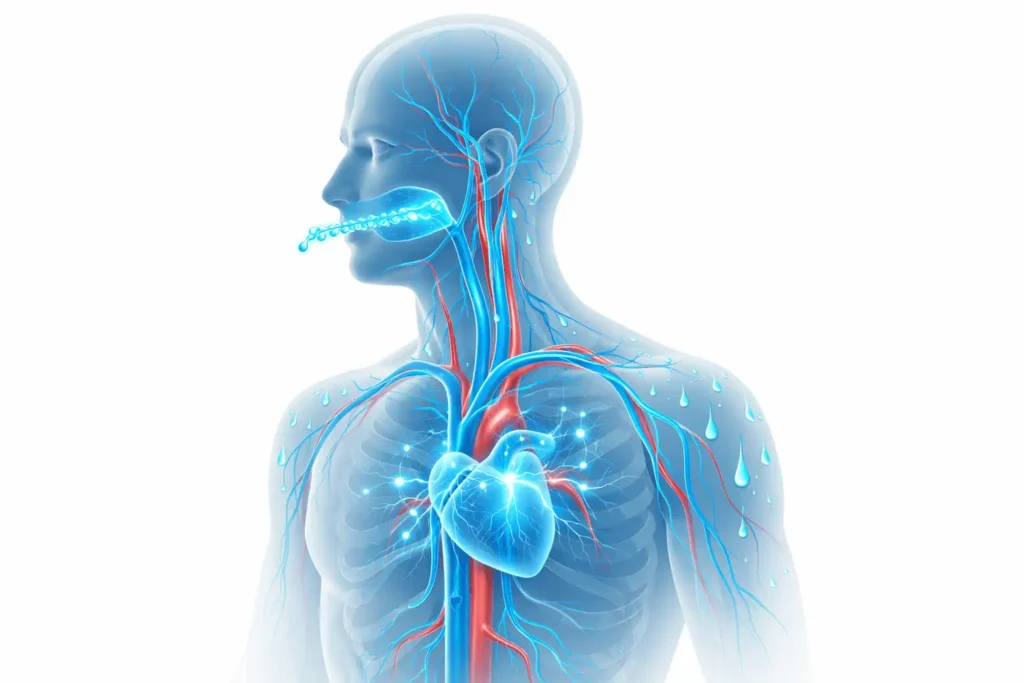
Can drugs be transferred through bodily fluids? It is one of the most searched questions in drug education — and for good reason. Whether you are worried about a positive drug test, concerned about a partner’s drug use, or simply curious about the science, understanding how substances move through the body’s fluids has real, practical implications. The short answer is: yes, in some cases drugs can be transferred through bodily fluids — but the amounts involved, and their real-world impact, vary enormously depending on the substance and the type of fluid involved.
This comprehensive guide covers every major pathway: saliva, semen, sweat, blood, breast milk, and the placenta — drawing on scientific research to give you clear, factual answers.
| Medical Disclaimer: This article is for educational purposes only and does not constitute medical or legal advice. If you or someone you know is struggling with substance abuse, please seek professional help. |
What You Will Find in This Guide
- What does drug transfer through bodily fluids mean?
- Can drugs be transferred through saliva (kissing)?
- Can drugs be transferred through semen or sperm?
- Can THC specifically be transferred through bodily fluids?
- Can you fail a drug test because of a partner’s bodily fluids?
- Can drugs be transferred through sweat?
- Can drugs pass through breast milk?
- Can drugs cross the placenta during pregnancy?
- How to protect yourself
- When to seek help for substance abuse
What Does ‘Drug Transfer Through Bodily Fluids’ Mean?
When we ask whether drugs can be transferred through bodily fluids, we are asking whether substances — or their metabolites — present in one person’s body can enter another person’s body through physical contact involving fluid exchange. This can happen through kissing, sexual activity, breastfeeding, pregnancy, or even shared environments where sweat is a factor.
The scientific term for how drugs move through the body is pharmacokinetics — the study of how a substance is absorbed, distributed, metabolised, and excreted. Once a drug enters the bloodstream, trace amounts can appear in virtually every bodily secretion, from saliva and sweat to semen and breast milk. The key question is always: are those trace amounts significant enough to cause intoxication or a positive drug test?
According to research from the National Institute on Drug Abuse (NIDA), drug metabolites can persist in bodily fluids for varying lengths of time after use, which is why fluid-based drug testing is possible at all. [1]
Can Drugs Be Transferred Through Saliva (Kissing)?
This is perhaps the most documented area of drug transfer through bodily fluids, thanks to several high-profile sports doping cases. The evidence suggests that yes, trace amounts of drugs can pass through saliva — but whether those amounts are sufficient to cause intoxication or a positive drug test is highly unlikely.
The Shawn Barber Case
In 2016, Canadian pole vaulter Shawn Barber tested positive for cocaine metabolites after competing at the Edmonton Canadian Championships. He claimed to have absorbed the drug through kissing a woman who had used cocaine shortly beforehand. His case was ultimately dismissed after his lawyers presented compelling evidence to the doping tribunal, including a voluntary hair follicle test that showed no pattern of regular cocaine use. [2]
The Richard Gasquet Case
French tennis player Richard Gasquet faced a similar situation in 2009 when he tested positive for trace amounts of cocaine. He attributed this to kissing a woman he had met at a nightclub in Miami. The Court of Arbitration for Sport exonerated him after finding the cocaine levels in his system were consistent with inadvertent transfer rather than intentional use. [3]
What the Science Says About Saliva Transfer
Dr. David Juurlink from Sunnybrook Research Institute, who served as a consulting expert in the Barber case, stated: “It’s very difficult to imagine a scenario in which the exchange of saliva through kissing transfers from one person to another a sufficient amount of cocaine to result in a positive urine test.” He added that while not impossible, it is “extraordinarily improbable.”
The key factor is concentration. Saliva typically contains far lower drug concentrations than blood or urine. For a transferred amount to register on a standard drug test, the exchange would need to be very recent and very substantial.
| Key Takeaway: Drugs can appear in saliva and may transfer through kissing in trace amounts. However, the quantity is almost always too small to cause a positive drug test or any psychoactive effect in the recipient. |

Can Drugs Be Transferred Through Semen or Sperm?
Can drugs be transferred through bodily fluids during sexual intercourse? Research confirms that drugs and their metabolites can indeed be present in semen, though in very low concentrations.
A developmental and reproductive toxicology report found that chemical concentrations in semen are generally comparable to or lower than those found in blood. Crucially, by the time any drug present in semen would enter a female partner’s bloodstream through vaginal absorption, the concentration would be three to five magnitudes lower than in the male partner’s blood. [4]
Why Vaginal Absorption Is Limited
While the vaginal epithelium — the lining of the vaginal walls — is capable of absorbing certain substances, several factors make significant drug transfer through semen unlikely:
- The volume of semen produced during intercourse is too small for meaningful chemical transfer.
- Post-intercourse leakage further reduces contact time between semen and the vaginal wall.
- The mucous barrier of the vaginal epithelium limits absorption of large molecules.
- Drug concentrations in semen are already very low relative to blood levels.
A landmark study by Leah Klemmt and Anthony R. Scialli of the College of William and Mary concluded that while certain psychoactive drug chemicals can be transported in semen, it remains highly doubtful that they could intoxicate a sexual partner or cause a failed drug test. Their research called for further study before any definitive conclusions could be drawn. [5]
| Key Takeaway: Drugs can be detected in semen, but the quantity transferred to a partner during sex is almost certainly too small to cause intoxication or a positive drug test. |
Can THC Be Transferred Through Bodily Fluids?
Given the widespread use of cannabis, this is one of the most commonly asked questions about drug transfer. The answer requires understanding THC’s unique chemistry.
THC in Semen and Vaginal Fluids
Studies have confirmed that THC (tetrahydrocannabinol) is detectable in vaginal fluids, semen, and breast milk. A 2022 study found quantifiable traces of THC metabolites in the semen of chronic users of inhaled cannabis. [6]
THC is fat-soluble, meaning it binds to fat cells and is released slowly into the bloodstream and bodily secretions during metabolism. During unprotected sexual activity, semen containing trace THC comes into contact with mucous membranes in the genitals, anus, or mouth. However, due to the very low concentration of THC in semen, it is unlikely that the traces transmitted are sufficient to cause psychoactive effects.
Factors That Influence THC Transfer
- Frequency and recency of cannabis use by the partner
- The consistency and volume of bodily fluids exchanged
- Presence of cuts, sores, or abrasions on mucous membranes
- Use of condoms or other barrier methods
- Individual metabolism and body fat percentage
THC and Kissing
The question of whether THC can be transferred through kissing follows the same logic as cocaine transfer through saliva. While THC can be present in saliva — especially immediately after smoking or consuming cannabis — the concentration drops rapidly. Casual kissing hours after cannabis use is extremely unlikely to result in any meaningful transfer.
| Key Takeaway: THC can be detected in semen, vaginal fluids, and saliva. Transfer through intimate contact is possible in theory, but concentrations involved are generally too low to cause psychoactive effects or a failed drug test in the recipient. |
Can You Fail a Drug Test Because of a Partner’s Bodily Fluids?
This is the most practically important question for many readers, particularly those facing workplace or legal drug testing. The answer, based on current evidence, is: almost certainly not.
Standard drug tests — whether urine, blood, saliva, or hair follicle — are calibrated to detect drug concentrations above a set threshold level. This threshold exists specifically to rule out incidental or passive exposure. Even if trace amounts of a drug enter your body through a partner’s saliva or semen, the quantity would almost certainly fall far below the cutoff required to trigger a positive result.
Drug Test Types and Their Sensitivity
| Test Type | What It Detects | Detection Window | Risk from Transfer |
|---|---|---|---|
| Urine | Drug metabolites | 1–30 days | Extremely Low |
| Saliva | Recent use | 1–3 days | Very Low |
| Blood | Active compounds | Hours–days | Negligible |
| Hair Follicle | 90-day history | Up to 90 days | Negligible |
If you have upcoming drug testing and are concerned, consider reading our guide on 12 best apps for addiction recovery support — several of these tools help track substance use and provide accountability support.
| Key Takeaway: Failing a drug test due to a partner’s bodily fluids is extremely unlikely. Drug tests are threshold-based, and the trace amounts that could be transferred are well below any standard cutoff level. |
Can Drugs Be Transferred Through Sweat?
Sweat is a less commonly discussed pathway, but it is relevant — particularly in workplace settings where sweat patch drug testing exists.
Drugs and their metabolites can be excreted through sweat glands. Methamphetamine, cocaine, opioids, and THC have all been detected in sweat samples. The concentration in sweat is typically very low, and the risk of meaningful transfer to another person through casual skin contact — like a handshake or a hug — is negligible.
Sweat patch testing, used in some probation and legal monitoring programmes, works by accumulating sweat over several days to detect drug use patterns over time. This method is sensitive enough to detect drug use, but not environmental contamination from another person’s sweat.
| Key Takeaway: Drugs can appear in sweat but the concentration is very low. Transfer to another person through normal skin contact is not considered a meaningful exposure risk. |
Can Drugs Pass Through Breast Milk?
Unlike the other fluid pathways discussed above, drug transfer through breast milk is a well-established and serious concern. This is not a trace-amount situation — infants can receive significant drug doses through breastfeeding.
THC, in particular, has a high affinity for breast milk due to its fat-soluble nature. Breast milk consists of approximately 3–5% fat content, making it an effective carrier for THC. Studies have detected THC in breast milk for up to six days after last cannabis use in regular users.
According to the American Academy of Pediatrics, no amount of cannabis, alcohol, cocaine, opioids, or methamphetamine is considered safe for breastfeeding infants. Exposure through breast milk has been linked to developmental delays, altered brain development, and withdrawal symptoms in newborns. [7]
- Cannabis (THC): Detectable in breast milk for up to 6 days
- Alcohol: Passes freely into breast milk at levels similar to blood
- Cocaine: Detectable in breast milk and highly dangerous to infants
- Opioids: Can cause neonatal abstinence syndrome (NAS) in breastfed infants
- Methamphetamine: Concentrates in breast milk at levels exceeding maternal blood

Can Drugs Cross the Placenta During Pregnancy?
Yes — and this is another area where drug transfer through bodily fluids carries serious, well-documented consequences. All drugs can cross the placenta to some degree through a process known as transplacental transfer.
Just as oxygen and nutrients pass from the mother’s bloodstream across the placenta to the fetus, so do drug metabolites. According to Stanford Children’s Health, drug use during pregnancy is associated with a range of serious outcomes for the infant. [8]
Effects of Drug Use During Pregnancy
- Cocaine: Miscarriage, premature placental detachment, high blood pressure, preterm delivery, and stillbirth.
- Cannabis (THC): Cognitive and behavioural deficits in the developing baby, including attention and memory problems.
- Methamphetamine: Miscarriage, preterm delivery, low birth weight, and developmental delays.
- Heroin and opioids: Neonatal Abstinence Syndrome (NAS) — the baby is born physically dependent and experiences withdrawal after birth.
- Alcohol: Fetal Alcohol Spectrum Disorders (FASDs), the leading preventable cause of intellectual disability in children.
If you are concerned about the long-term effects of prenatal drug exposure, our article on effects on babies born addicted to drugs provides a comprehensive overview.
| Key Takeaway: Drug transfer through the placenta is not trace-level — it is significant enough to cause addiction, developmental disorders, and life-threatening conditions in newborns. This is one of the strongest reasons to seek help for substance use before or during pregnancy. |
How to Protect Yourself and Your Partner
Understanding that drugs can be transferred through bodily fluids — even in small amounts — underlines the importance of open communication between partners about substance use. Here are practical steps you can take:
- Use barrier methods (condoms) during sexual activity if either partner uses substances
- Avoid kissing immediately after a partner has used drugs, particularly cocaine
- Do not breastfeed while actively using any illicit substance or alcohol
- Seek medical advice before any recreational drug or medication use during pregnancy
- Be aware that sweat patches used in drug testing can be affected by exposure to methamphetamine environments
- Have honest conversations with your healthcare provider about substance use — they can advise on reducing risks to partners and children
When to Seek Help for Substance Abuse
If you are researching whether drugs can be transferred through bodily fluids, there is a chance that drug use — yours or a partner’s — is affecting your life or relationships. Recognising this is an important step.
Substance use disorders are treatable. If you or someone close to you is struggling, the following resources on our site may help:
- 12 Best Apps for Addiction Recovery Support — tools to help track and manage recovery
- 5 Stages of Addiction Recovery Explained — understanding the recovery journey
- Top 7 Holistic Therapies for Addiction Recovery — alternative and complementary approaches
- How Family Therapy Helps in Addiction Treatment — support for the whole family
- Life-Changing Benefits of Sober Living Homes — structured recovery housing options
You can also reach the SAMHSA National Helpline at 1-800-662-HELP (4357) — a free, confidential, 24/7 treatment referral and information service for individuals and families facing substance use disorders.

Conclusion
So, can drugs be transferred through bodily fluids? The answer is nuanced. In most intimate contact scenarios — kissing, sex — the amounts transferred are trace-level and almost certainly too small to cause intoxication or a failed drug test. However, in critical biological relationships — mother to fetus via the placenta, or mother to infant via breast milk — drug transfer is substantial, medically significant, and potentially life-altering.
The science is clear: the pathway and the relationship between the people involved matters enormously. Protecting yourself and those you care about means staying informed, communicating openly with partners, and seeking help when substance use becomes a problem.
Sources and Citations
[1] National Institute on Drug Abuse (NIDA). Drug Testing.
[2] CBC Sports. Shawn Barber cocaine case.
[3] Reuters. Richard Gasquet cocaine case.
[4] Juurlink, D. et al. Drug concentrations in semen relative to blood. Developmental and Reproductive Toxicology Reports.
[5] Klemmt, L. & Scialli, A.R. The transport of chemicals in semen. Birth Defects Research Part B. College of William and Mary, Virginia.
[6] Pacifici, R. et al. (2022). THC metabolites in semen of chronic cannabis users. Journal of Analytical Toxicology.
[7] American Academy of Pediatrics (AAP). Substance Use During Breastfeeding Policy Statement.
[8] Stanford Children’s Health. Illegal Drug Use and Pregnancy. https://www.stanfordchildrens.org