
Motivational Interviewing (MI) is a counseling method designed to help individuals work through ambivalence about change, particularly in addiction recovery. Instead of confronting or pressuring individuals, MI uses empathy, reflective listening, and collaboration to guide them toward uncovering their own reasons for change. Research shows MI can significantly reduce substance use, with just one session doubling abstinence rates.
Key Points:
- Ambivalence: Feeling torn between quitting and continuing substance use is common and can stall recovery.
- MI Approach: Focuses on empathy, exploring discrepancies between actions and values, and addressing resistance without confrontation.
- Effectiveness: Over 200 clinical trials confirm MI’s success in improving recovery outcomes.
- Steps in MI:
- Build trust with reflective listening.
- Encourage “change talk” by asking open-ended questions.
- Address resistance with understanding, not confrontation.
- Collaborate on an actionable change plan.
MI empowers individuals to resolve internal conflicts and align their actions with personal goals, leading to meaningful progress in recovery.
What is Ambivalence in Addiction Recovery
Defining Ambivalence
Ambivalence is that inner tug-of-war where someone feels torn about making a change. In addiction recovery, it often means wanting to quit substances while still feeling tied to them. For example, someone might say, “I need to quit for my family”, but also, “I need this to relax after work.” This push-and-pull shows up in what’s called “sustain talk” – reasons to stick with the current behavior (like “I drink to unwind”) – and “change talk”, which reflects the desire for improvement (such as “I need to be there for my kids”). Recognizing this internal conflict is a key step in understanding why timely intervention is so important.
Why Addressing Ambivalence Matters
When ambivalence goes unresolved, it can stall recovery. Mixed emotions are normal, but staying stuck in this indecision can prevent progress. Research highlights that when sustain talk dominates therapy sessions, treatment outcomes often suffer. On the other hand, stronger expressions of change talk are linked to better success rates and fewer relapses.
“Frequently, client ambivalence is a roadblock to change, not a lack of knowledge or skills about how to change.” – Forman & Moyers
The real challenge isn’t that people don’t understand the harm caused by substance use – it’s that they’re caught between the perceived benefits (like stress relief or social connection) and the heavy costs (health issues, strained relationships, legal trouble). Until the scale tips toward change, they may remain stuck in this back-and-forth. This is why Motivational Interviewing, a technique proven in over 200 clinical trials, focuses on resolving ambivalence to improve outcomes in treating substance use disorders.
sbb-itb-17645e5
Motivational Interviewing: Ambivalence, Change Talk, & Sustain Talk
Core Principles of Motivational Interviewing
Motivational Interviewing (MI) is built around three key principles that help individuals work through their mixed emotions about change. Rather than directing or instructing, counselors create a collaborative partnership, guiding clients toward their own insights. This approach has been shown to be highly effective in addressing substance use disorders. At its heart lies empathy, which sets the tone for meaningful engagement.
Expressing Empathy
Empathy in MI goes beyond simply listening – it’s about truly understanding the client’s perspective without judgment. Instead of rushing to offer solutions (a common “righting reflex”), counselors use reflective listening to show they genuinely care about the client’s feelings and viewpoint. This technique creates a safe environment where clients can openly explore their conflicting emotions.
Research highlights the importance of reflective listening, suggesting a ratio of two or three reflections for every question leads to better outcomes. For instance, if a client shares that they feel lonely, a counselor might respond, “It sounds like you’ve been feeling isolated lately,” rather than immediately probing for details. This kind of response helps clients feel understood and lowers defensiveness, encouraging them to discuss change instead of justifying their substance use.
“A compassionate stance essentially says, ‘I am here to support your well-being, whatever that looks like for you.’ It’s the glue that holds the therapeutic alliance together.” – South Shore Recovery
Developing Discrepancy
Here, the focus is on helping clients see the gap between their current behavior and their long-term goals or values. The critical element is that clients come to this realization themselves, rather than being told by the counselor. For example, someone might recognize that their substance use clashes with their desire to be a supportive parent or maintain good health. This awareness creates an internal tension that drives change.
A counselor might ask, “How does your current drinking fit with your goal of rebuilding trust with your family?” By encouraging clients to articulate their own reasons for change, counselors help them take ownership of the process. Studies show this approach is far more effective than trying to persuade clients with external arguments.
“People are more likely to change when they can see that their actions are not in line with their values.” – Joshua Schultz, Psy.D.
Rolling with Resistance
Resistance is treated differently in MI – it’s not seen as denial or stubbornness but as a natural part of ambivalence. When resistance arises, counselors adapt their approach rather than confronting it head-on. For example, if a client expresses mixed feelings about their substance use, a counselor might say, “You’ve mentioned that using helps you relax after work, but you’re also worried about your health. That’s a tough spot to be in.”
This non-confrontational response acknowledges both sides of the client’s feelings, reducing defensiveness and keeping the conversation productive. By treating resistance as an opportunity for exploration rather than a barrier, counselors encourage clients to examine their motivations without feeling pressured into change.
These principles work together to help clients resolve ambivalence and move toward recovery.
| MI Approach | Directive Approach |
|---|---|
| Collaborative partner/guide | Authority figure/expert |
| Motivation evoked from within the client | Motivation imposed through persuasion |
| Resistance signals need to change direction | Resistance seen as denial to confront |
| Goal: Resolve ambivalence and build autonomy | Goal: Ensure compliance with a plan |
How to Resolve Ambivalence Using MI: A Step-by-Step Process
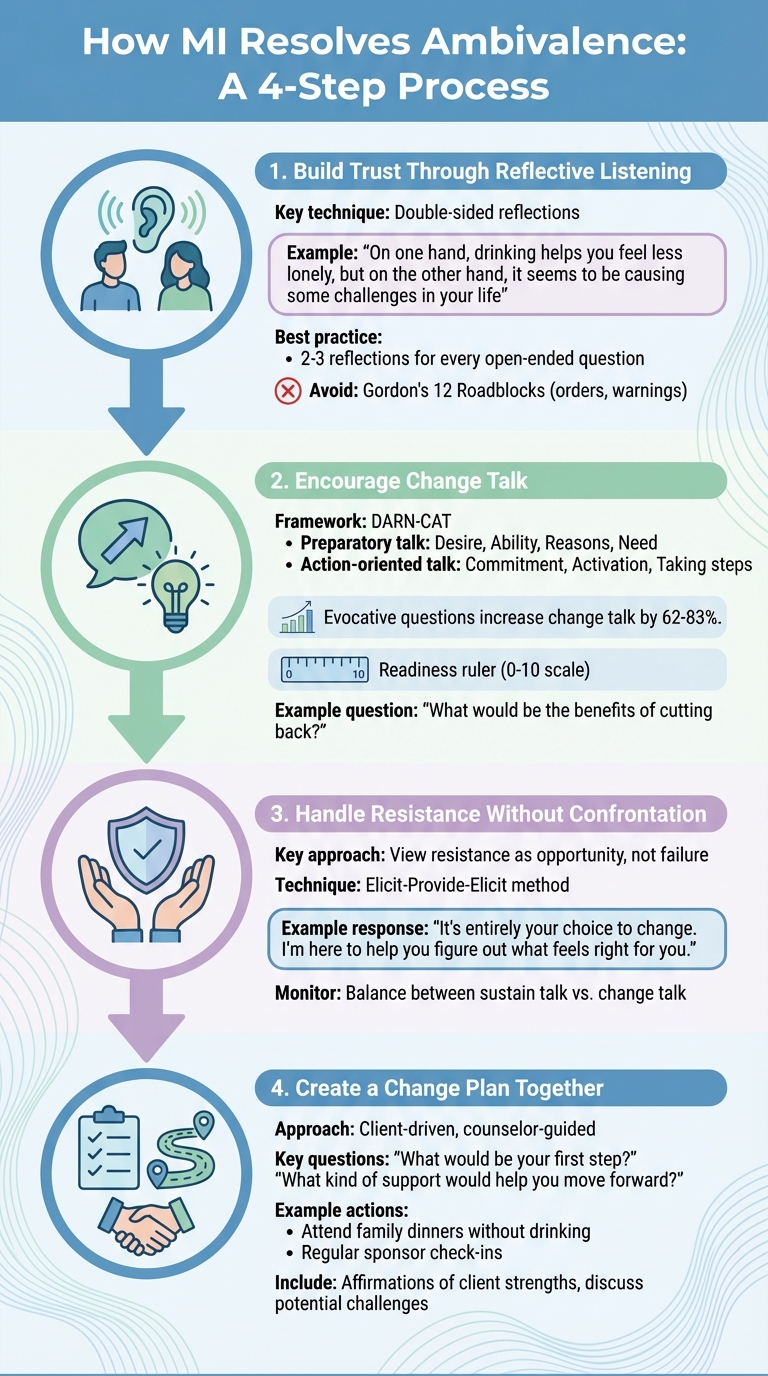
4-Step Motivational Interviewing Process for Resolving Ambivalence in Addiction Recovery
By combining empathy, identifying discrepancies, and managing resistance, this approach brings the principles of Motivational Interviewing (MI) to life. These steps offer a practical framework for helping clients work through ambivalence and move toward change.
Step 1: Build Trust Through Reflective Listening
Reflective listening is central to MI. It involves actively interpreting the emotions or meanings behind what a client says. For example, if a client says, “I drink because I’m lonely”, a basic reflection might be, “You feel lonely.” A more in-depth reflection could be, “It seems like making connections is tough for you, and drinking has become a way to deal with that loneliness.”
When addressing ambivalence, double-sided reflections can be especially helpful. These acknowledge both the pros and cons of a behavior. For instance, you might say, “On one hand, drinking helps you feel less lonely, but on the other hand, it seems to be causing some challenges in your life”. Aim to include two to three reflections for every open-ended question. Avoid behaviors like giving orders or issuing warnings (often referred to as “Gordon’s 12 Roadblocks“), as these can shift focus away from the client and weaken their trust in the process. Establishing this trust is crucial for encouraging the client to explore their own reasons for change.
Step 2: Encourage Change Talk
Once trust is built, the next step is to draw out the client’s internal motivations for change. The DARN-CAT framework breaks this down into two types of language: preparatory talk (Desire, Ability, Reasons, Need) and action-oriented talk (Commitment, Activation, Taking steps).
Evocative questions are key to sparking change talk. Instead of asking, “Do you think you should quit drinking?” you might try, “What would be the benefits of cutting back?” or “Why might you want to make this change?” Research shows that well-crafted questions like these can increase the likelihood of eliciting change talk by 62% to 83%.
Using tools like the readiness ruler (rating readiness on a scale of 0–10) can also help. For example, asking, “Why did you choose a 5 instead of a lower number?” encourages clients to reflect on their readiness. Reflecting on their responses with deeper insights and summarizing their ambivalence while highlighting their desire for change can further solidify their commitment. This approach naturally leads to addressing moments of hesitation.
Step 3: Handle Resistance Without Confrontation
Resistance is a normal part of ambivalence and not a sign of failure. MI views resistance as an opportunity to explore rather than confront. Using reflective listening and the Elicit-Provide-Elicit technique can help clients feel understood while keeping the focus on their autonomy.
For example, a counselor might say, “It’s entirely your choice to change. I’m here to help you figure out what feels right for you.” Reinforcing client autonomy can ease resistance. Monitoring the balance between “sustain talk” (reasons to stay the same) and “change talk” is also important. If a client seems stuck, asking them to rate their confidence on a scale of 1–10 – and exploring why they didn’t choose a lower number – can help them recognize their own strengths and move forward. Once resistance is addressed, clients are better prepared to outline specific action steps.
Step 4: Create a Change Plan Together
The final step is to work with the client to develop a realistic and actionable change plan. Rather than offering solutions, counselors guide clients to identify steps that align with their values and goals. Questions like, “What would be your first step?” or “What kind of support would help you move forward?” encourage clients to take ownership of the process.
For example, a client’s plan might include attending family dinners without drinking or setting up regular check-ins with a sponsor. Throughout this process, affirmations that highlight the client’s strengths – like acknowledging the courage it took to seek help – can boost their confidence. Discussing potential challenges and brainstorming ways to overcome them further reinforces their belief in their ability to achieve lasting change.
Benefits of Using MI in Addiction Recovery
Motivational Interviewing (MI) has proven to be a powerful tool for addressing ambivalence, leading to better engagement, stronger internal motivation, and more enduring recovery outcomes. Backed by evidence from over 200 randomized clinical trials, MI has shown success in reducing substance use and supporting recovery efforts.
Better Client Engagement
MI shifts therapy into a collaborative partnership, utilizing OARS skills – open-ended questions, affirmations, reflective listening, and summarizing – to encourage active participation and open communication. Instead of taking on the role of an authority figure, the counselor adopts a guiding approach, working alongside the client as an equal partner.
“Counselor MI spirit is associated with positive client engagement behaviors (e.g., self-disclosure, cooperation).” – SAMHSA
This approach respects the client’s autonomy, recognizing them as the expert in their own life. It creates a safe space for clients to express concerns and set goals without fear of judgment. Research highlights that for MI to be effective, at least 70% of the counselor’s questions should be open-ended. By avoiding confrontation and instead “rolling with resistance”, MI reduces the likelihood of non-compliance or treatment refusal, issues that often undermine traditional methods. For example, a multisite study found that incorporating MI during the initial intake session significantly improved patient retention during the crucial first 28 days of treatment.
Stronger Motivation for Lasting Change
What sets MI apart is its ability to build motivation from within. Rather than using external pressure, MI helps clients uncover their own reasons for change through developing discrepancy – exploring the gap between their current behaviors and their personal values or future aspirations. This self-driven motivation is far more sustainable than external persuasion.
MI strengthens commitment through what is often called the “Rule of Three.” When clients hear their own “change talk” three times – once when they say it, again when the counselor reflects it back, and a third time during a summary – it reinforces their resolve. Research underscores this, showing that individuals who received just one MI session during intake had double the abstinence rates compared to those who didn’t. As William R. Miller, PhD, Co-founder of MI, explains:
“You hear yourself talk, and you get committed to what you hear yourself saying.”
This process not only strengthens motivation but also helps resolve the internal conflicts often tied to ambivalence.
Better Recovery Results
The collaborative and empowering nature of MI directly contributes to improved recovery outcomes. Beyond reducing substance use, MI fosters self-efficacy and independence – key factors for maintaining long-term recovery. Providers who ask evocative questions are 62% to 83% more likely to elicit “change talk” from clients. This is critical because when clients voice their own reasons for change, they are more likely to act on them.
MI also reduces treatment dropout, a common issue with more confrontational approaches. The result is not just short-term compliance but a deeper sense of empowerment and self-directed change that lasts well beyond the therapy sessions.
Conclusion
Motivational Interviewing (MI) approaches ambivalence in addiction recovery as a natural part of the change process, not as resistance. This perspective opens the door for individuals to explore their values and identify personal, meaningful reasons to pursue recovery. By focusing on internal conviction rather than external pressures, MI helps foster self-motivation, which is key to long-term change.
This method isn’t about using tricks or techniques to force change. Instead, it’s a collaborative process that supports individuals in working through their own mixed feelings and uncovering their own reasons for transformation. As South Shore Recovery puts it:
“MI isn’t a bag of tricks to get people to change. It’s a way of helping them solve their own ambivalence and find their own reasons for making a change.” – South Shore Recovery
The effectiveness of MI is well-documented. A meta-review of 59 randomized trials involving over 13,000 participants found that MI significantly reduced substance use for up to 12 months after treatment. While MI helps spark the internal drive for change, professional guidance remains critical to turning that motivation into lasting recovery.
Clinicians trained in MI use empathy and collaboration to help clients move past ambivalence. By employing strategies like reflective listening, encouraging change talk, addressing resistance without confrontation, and developing actionable plans, they build trust and provide the tools needed for meaningful change. When paired with robust support systems, this approach creates a strong foundation for lasting recovery.
FAQs
How is MI different from confrontation-based counseling?
Motivational Interviewing (MI) is a person-centered counseling method that focuses on working with individuals rather than against them. It prioritizes empathy, understanding, and acceptance, creating a safe space where people can openly explore their thoughts and feelings. Unlike approaches that rely on confrontation or pressure, MI gently guides individuals to address their uncertainties and discover their own motivation for change. This supportive, non-judgmental style encourages self-reflection and empowers people to take steps toward meaningful, self-driven progress.
What should I do if my “sustain talk” feels stronger than my desire to change?
It’s completely natural to feel torn or uncertain when you’re going through a period of change. Instead of trying to push yourself into action, take some time to explore those mixed feelings. Think about what’s holding you back, but also weigh the potential benefits of making a change. Talking things through with a counselor who specializes in motivational interviewing can be incredibly helpful. This kind of conversation can give you a clearer understanding of your hesitation and help build the drive you need to take the next step.
Can MI work in one session, or does it take multiple sessions?
Motivational interviewing can work even in just one session to help tackle ambivalence and encourage change. That said, it’s commonly used as part of multiple sessions, each designed to align with the person’s unique needs and recovery objectives.