
Islamic rehab programs combine spiritual practices with clinical methods to address addiction as a physical, psychological, and spiritual challenge. They integrate Islamic principles, such as dhikr (remembrance of God), tazkiyah al-nafs (self-purification), prayer, and Quranic study, into treatment. These programs also emphasize community and family support to strengthen recovery and reintegration.
Key Insights:
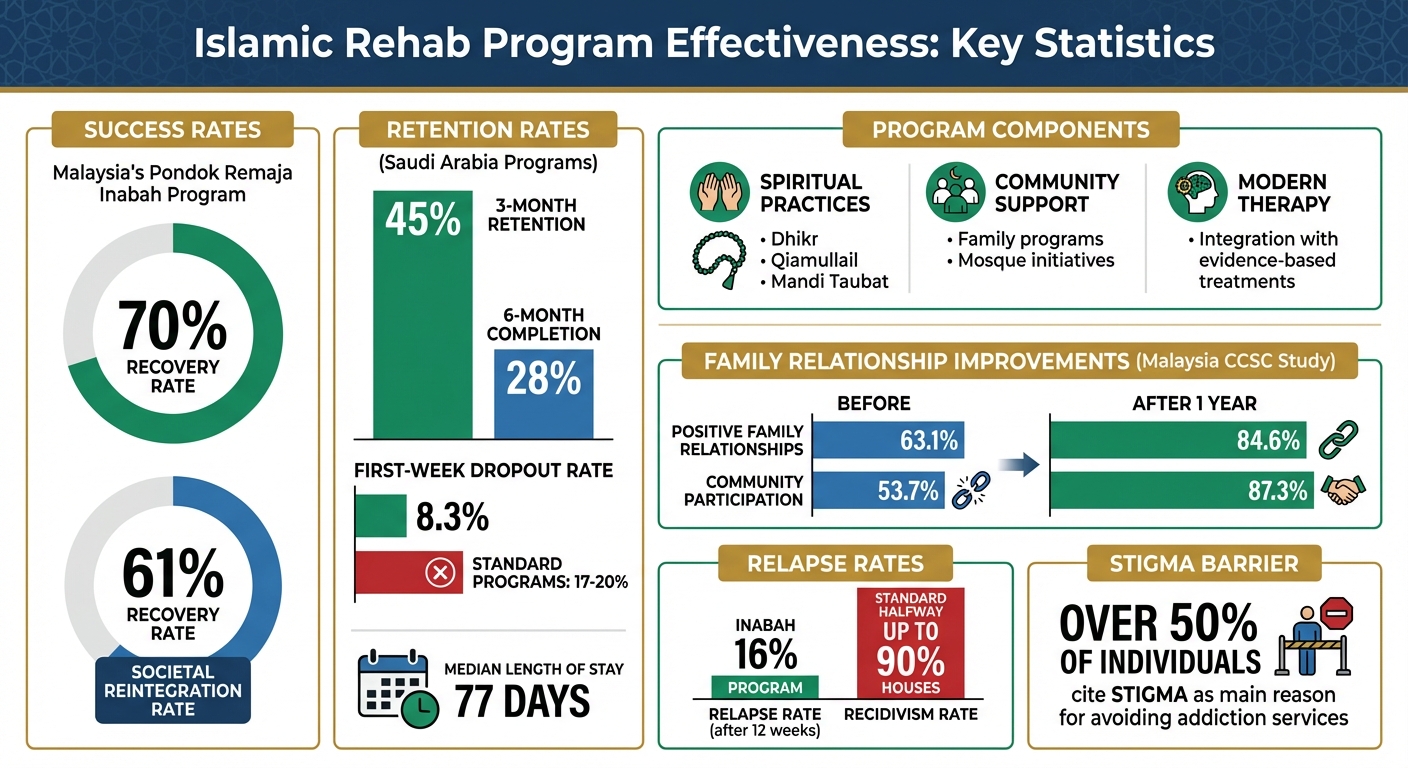
- Success Rates: Malaysia’s Pondok Remaja Inabah program reports a 70% recovery rate, with 61% achieving societal reintegration.
- Retention: Saudi programs show retention rates comparable to global standards, with a 45% three-month retention rate and 28% completing six months.
- Spiritual Practices: Techniques like dhikr, Mandi Taubat (Repentance Bath), and Qiamullail (night prayers) aid emotional regulation and mental discipline.
- Community Support: Programs like “Mosque as Foster Parents” and family-focused initiatives improve relationships and reduce stigma.
Challenges:
- Stigma: Addiction is often viewed as a moral failing, discouraging individuals from seeking help.
- Limited Accessibility: Programs often focus on adult males, leaving out women and adolescents.
- Integration: Combining spiritual practices with modern therapies can improve outcomes.
Islamic rehab programs show promise in addressing addiction holistically, with strong community ties and spiritual foundations. However, addressing stigma, expanding access, and integrating evidence-based therapies are areas for growth.
Islamic Rehab Program Success Rates and Key Statistics
Overcoming Addiction: An Islamic Approach to Recovery (The Silent Spiritual Crisis Amongst Muslims
sbb-itb-17645e5
Core Components of Islamic Rehab Programs
Islamic rehab programs tackle addiction by addressing physical, psychological, and spiritual dimensions.
Spiritual and Religious Counseling
A central feature of Islamic rehab is its focus on spiritual healing. One key practice is dhikr – the repetitive remembrance of Allah – which helps regulate emotions and ease stress. This can take various forms, including silent reflection and group recitations.
The process of Tazkiyah al-Nafs (soul purification) provides a structured path for personal growth. It unfolds in three stages: Takhalli (removing negative traits), Tahalli (cultivating positive qualities), and Tajalli (achieving spiritual clarity). This framework extends beyond simply quitting substance use, offering a roadmap for deeper transformation.
In July 2025, the Sinar Jati Foundation in Lampung, Indonesia, demonstrated how integrating prayer, dhikr, and Quranic study into conventional rehab improved emotional regulation in clients with impulse control challenges. Under the guidance of two trained counselors, three clients showed significant behavioral improvements.
Other practices, like Mandi Taubat (Repentance Bath), symbolize a fresh start, while Qiamullail (night prayers) builds mental discipline and resilience through consistent worship. The Medan Plus Rehabilitation Foundation in Indonesia adds nightly evaluations to these spiritual routines, creating opportunities for reflection and accountability.
These spiritual practices are further strengthened by strong community and family support systems.
Community and Family Support
Islamic rehab programs emphasize repairing and nurturing social connections as part of recovery. For example, the Halaqah program offers ongoing religious classes for both individuals in recovery and their families, fostering shared healing. A study of 10 Community-Based Cure and Care Service Centers (CCSC) in Malaysia revealed improvements in family relationships, with the percentage of clients maintaining positive ties with their parents rising from 63.1% to 84.6% after a year of religious programming.
The “Mosque as Foster Parents” initiative uses local mosques as support hubs, helping individuals transition back into community life. Participants also engage in volunteer work at mosques, which not only aids reintegration but also allows them to contribute meaningfully to society. Participation in these community programs rose from 53.7% to 87.3% after active involvement.
“The common emphasis of spirituality on relationship with God, self and others, may significantly influence how people cope with the challenges of drug addict”, explains researcher Nor Hanim Elias.
The collective power of the Jemaah (group) effect is also a vital component. This supportive environment helps individuals maintain abstinence. For example, the Inabah program, a traditional model, reported relapse rates as low as 16% after 12 weeks of treatment.
Combined Treatment Approaches
Islamic rehab programs often blend spiritual and communal elements with modern therapeutic methods, creating a well-rounded approach to recovery.
The Inabah Philosophy, for instance, combines Sufi practices with psychological methods, achieving impressive rates of recovery and social reintegration. Some programs also adopt a “Cold Turkey” approach, focusing on intense spiritual guidance instead of pharmacological detox, paired with psychological counseling and life skills training.
In May 2025, researchers highlighted the Tamarkoz dhikr method, which modernizes traditional Islamic meditation by incorporating heart-focused movement, visualization, and deep breathing. A Berkeley University study found that participants using this method experienced lower stress levels and more positive emotions compared to those in standard stress management programs.
“Traditional Islamic SMPs [Spiritual Meditative Practices] have remained largely hidden or misunderstood… they hold great promise as universally adoptable cogent modern psychotherapies”, note researchers Farah R. Zahir and M. Walid Qoronfleh.
Recent Research Findings
Success Rates Compared to Standard Rehab
Research indicates that Islamic rehab programs achieve retention and completion rates comparable to global standards. Between 2000 and September 2014, Abdulaziz Alshomrani conducted an analysis of five Addiction Therapeutic Communities (ATCs) in Saudi Arabia, studying 2,003 male residents from facilities in Dammam, Riyadh, Jeddah, and Taif. The study found that 45% of participants stayed in the program for at least three months, while 28% completed the full six-month program.
These figures align with global rehab benchmarks, which report three-month retention rates ranging from 30% to 50%. Notably, the first-week dropout rate was only 8.3%, significantly lower than the 17% to 20% dropout rates often seen in standard rehab programs. Additionally, the median length of stay was 77 days, surpassing the 70-day average in English residential facilities and far exceeding the 39-day median reported in Australian studies.
“Three-month retention, treatment completion, and dropout within the first week were reasonable, comparable, and consistent with reported rates worldwide. These rates can be considered an indicator of successful Saudi ATC programs”, stated Abdulaziz Alshomrani from the University of Bisha.
Malaysia’s Pondok Remaja Inabah (PRI) program also showcases strong outcomes, boasting a 70% recovery rate, with 61% of participants successfully reintegrating into society. This success prompted Malaysia’s National Anti-Drugs Agency to officially incorporate Islamic psychospiritual therapy through its Islamic Rehabilitation Approach Program (ISRA).
These statistics lay the groundwork for exploring how regional adaptations enhance the effectiveness of Islamic rehab programs.
Case Studies and Regional Examples
Case studies from various regions provide additional insights into the effectiveness of Islamic rehab practices. For instance, research from Indonesia demonstrates how integrating Islamic principles into rehabilitation programs can improve outcomes for participants.
In July 2025, Umi Aisyah and Fiqih Amalia published findings from the Sinar Jati Foundation in Lampung, Indonesia, which serves a nation grappling with approximately 3.3 million drug users aged 15–64. Their study followed three clients who initially struggled with motivation and impulse control. After incorporating prayer, dhikr (remembrance of God), and Quranic study into conventional rehabilitation, all three participants showed marked improvements in emotional regulation and adherence to religious practices.
“Incorporating Islamic spiritual values and practices into mental health counseling provides a holistic framework that enhances recovery outcomes for Muslim individuals struggling with drug addiction”, explained Umi Aisyah from UIN Raden Intan Lampung.
Another example comes from Yogyakarta, Indonesia, where a 2021 case study at Pesantren Tetirah Dhikr (PTD) followed 16 patients through a program rooted in dhikr and the three-stage Sufi process of soul purification. These traditional practices yielded therapeutic benefits comparable to those of modern transpersonal psychology, with participants experiencing greater mental and emotional stability.
The Medan Plus Rehabilitation Foundation in Indonesia employs a blended approach, combining Islamic counseling, dhikr, and nightly evaluations to reinforce resilience and sustain recovery efforts. This approach highlights how Islamic rehab programs can adapt to local needs while preserving their spiritual essence.
Challenges and Areas for Improvement
While Islamic rehab programs show promise, they face several hurdles that need addressing to improve their impact and accessibility.
Addressing Stigma Around Addiction
Stigma remains a major barrier preventing individuals from seeking help through Islamic rehab programs. Over 50% of participants in Muslim communities identified stigma as the main reason for avoiding addiction services. Addiction is often viewed as a moral failing rather than a medical condition, leading to shame and discouraging individuals from seeking treatment.
In 2020, Heba Ragheb spearheaded the “Inspiring Muslim Minds” program in Toronto, Canada. This initiative, implemented across nine mosques, offered 90-minute seminars that combined medical insights on addiction with Islamic teachings. The program reached 93 adult Muslims and resulted in notable improvements: participants showed increased willingness to consult medical doctors (t = 4.4; p < 0.001) and mental health professionals (t = 2.2; p = 0.03), alongside more positive attitudes toward people with addiction (p = 0.004). As Heba Ragheb explained:
“Evidence-informed spiritually-adapted outreach program in the mosque setting can help reduce addiction related stigma in Muslim communities”.
Confidentiality concerns and fears of discrimination also deter individuals from seeking help, though younger generations appear more open to change.
Addressing stigma is just one piece of the puzzle. To enhance effectiveness, these programs must also integrate modern therapeutic approaches.
Adding Modern Therapeutic Practices
To achieve better outcomes, Islamic rehab programs must combine their spiritual foundation with evidence-based medical and psychological therapies. This balance ensures that modern treatments align with religious values without compromising core principles.
Collaboration between Islamic counselors and medical professionals has proven effective in bridging knowledge gaps and overcoming treatment barriers. For example, framing rehabilitation as a religious obligation through Maqasid al-Syariah – specifically the preservation of the mind (al-hifdzu al-aql) – helps emphasize its importance beyond secular reasoning.
Retention remains another challenge. In Saudi Arabia, some programs report an 8.3% dropout rate within the first week and only a 28% six-month completion rate, with results varying significantly across centers. Mohd Zulhilmi Jusoh from Universiti Sains Islam Malaysia highlighted key factors for success:
“The challenge is the power of the group (Jemaah), the influence of a constructive atmosphere, the significance of good friends, and the importance of consistency”.
Additionally, demographic limitations pose another obstacle. Many traditional Islamic rehab programs, especially in Saudi Arabia, have historically focused on adult males, leaving out adolescents and women. Expanding access to these groups while maintaining cultural sensitivity is essential for broader impact.
Sober Living Centers: A Resource for Addiction Recovery
While the spiritual and communal aspects of Islamic rehab are invaluable, practical external support plays a key role in maintaining recovery. Sober Living Centers provides educational tools to complement Islamic rehab programs, particularly during the critical post-treatment phase. These resources are designed to guide individuals through the vulnerable transition to independent living.
The website offers materials on withdrawal and overdose, helping individuals navigate the challenges of early recovery. It also includes information on aftercare programs and sober living homes, addressing the difficulties many face in staying sober after completing treatment – a time when relapse risks are often heightened. Additionally, the guides focus on family involvement, tackling a common issue in Islamic programs where limited family engagement can hinder progress.
Sober Living Centers’ approach mirrors the communal “power of the group” (Jemaah) found in Islamic recovery programs. For instance, Clean and Sober Transitional Living in Sacramento, California, demonstrated the effectiveness of structured peer support. Between January 2004 and July 2006, this program used a peer-led “Residents Congress” and a phase-based system to support 245 residents. Over 18 months, participants experienced marked improvements in substance use, employment stability, and mental health. This alignment of structured peer support with faith-based principles enhances the overall recovery process.
Sober living homes are also financially accessible, costing around $695 per month, including meals and utilities. Kaitlyn Motley, Mental Health and Substance Use Services Director, highlights their importance:
“Sober living homes… help you to transition back into the community after intensive inpatient services and learn to live independently without the use of drugs and/or alcohol”.
These homes provide a crucial stepping stone, bridging the gap between intensive spiritual care and independent, sober living.
Conclusion
Key Takeaways
Islamic rehab programs, like the Inabah model, have demonstrated impressive recovery rates by blending spiritual practices with community-based support. For instance, Pondok Remaja Inabah in Malaysia consistently reports strong recovery outcomes and significantly lower relapse rates when compared to standard halfway house programs, which can experience recidivism rates as high as 90%.
The effectiveness of these programs stems from their psychospiritual approach. Practices such as dhikr (remembrance of God), Qiamullail (night prayers), and the three-stage purification process – takhalli, tahalli, and tajalli – are central to their success. These methods have shown high completion rates and better societal reintegration outcomes. As Abu Bakar Ahmad Mansor from Universiti Utara Malaysia highlights:
“Islamic psychospiritual therapy… has a proven positive impact in treating and rehabilitating former addicts through self-transformation to become human beings with intact spiritual and religious values”.
This evidence underscores the potential of these programs as a foundation for advancing addiction treatment strategies.
Future Directions
There’s a growing need to expand and refine these models through continued research. In 2017, the Malaysian government allocated RM357,231,000 to drug rehabilitation, while Indonesia reported 3.3 million drug users aged 15–64 as of 2023. Moving forward, combining evidence-based therapies, such as Cognitive Behavioral Therapy, with traditional spiritual practices could enhance outcomes. This approach has already shown promise in studies conducted at the Sinar Jati Foundation in Indonesia.
National agencies should prioritize investments in rigorous research to validate these programs further. Addressing the lack of professional mental health facilities in areas where faith-based rehabilitation is vital remains a pressing challenge. Malaysia’s Islamic Rehabilitation Approach Program (ISRA) serves as an excellent example of how government support can enhance these efforts. By merging Islamic spiritual practices with evidence-based therapeutic methods, these programs provide a well-rounded path to recovery. Adding educational tools, like those offered by Sober Living Centers, could strengthen recovery outcomes and ensure long-term reintegration into society.
FAQs
Who is Islamic rehab best suited for?
Islamic rehab programs offer a faith-centered approach for those who are open to incorporating spirituality into their recovery process. These programs weave together practices such as prayer, Quranic recitation, and dhikr to foster both sobriety and mental health. They resonate deeply with individuals who prioritize Islamic principles, value community connections, and seek a structured, religious foundation to navigate their path to recovery.
How can spiritual practices work with evidence-based therapy?
Spiritual practices can complement evidence-based therapy by addressing deeper emotional and spiritual needs. Activities such as prayer, meditation, and reflection help individuals develop emotional regulation, boost self-awareness, and encourage personal growth – all of which are crucial in addiction recovery. When paired with approaches like CBT, these practices create a more personalized and meaningful therapeutic experience. This combination can improve engagement, enhance motivation, and support long-term recovery, especially when aligned with a person’s own beliefs and values.
What aftercare helps prevent relapse after Islamic rehab?
Aftercare plays a crucial role in maintaining recovery and avoiding relapse following Islamic rehab. A well-rounded approach includes both spiritual and psychological support. Activities like halaqah (religious study circles), spiritual mentorship, and active participation in the community provide ongoing guidance and a sense of belonging.
Daily practices such as prayer, remembrance of Allah (zikir), and counseling sessions help build spiritual strength and emotional balance. When paired with relapse prevention techniques – like mindfulness – these practices equip individuals to manage triggers effectively, supporting a lasting recovery journey.